
Glycolysis represents a foundational metabolic cascade responsible for glucose breakdown to generate usable energy and sustain cellular viability. A unique strength of this pathway lies in its capacity to synthesize ATP, the universal intracellular energy carrier, without oxygen dependency. As a result, glycolysis supports energy supply under regular oxygen-rich environments and acts as a vital metabolic backup in hypoxic niches—such as overworked skeletal muscle during strenuous exercise or proliferating malignant tumor tissue.
A thorough grasp of glycolytic reaction sequences, core catalytic enzymes, upstream regulatory mechanisms and disease correlations lays a solid foundation for interpreting overall cellular metabolism and energy homeostasis.
Glycolysis refers to a conserved metabolic route that oxidizes glucose molecules and cleaves them into pyruvate, concurrently generating ATP and NADH cofactors. All glycolytic reactions take place within the cytoplasm, the aqueous matrix surrounding intracellular organelles. Beyond meeting cellular energy demands, this process yields intermediate substrates feeding downstream metabolic networks including the tricarboxylic acid cycle and anaerobic fermentation.
This ancient metabolic pathway exists in nearly all living organisms spanning prokaryotic bacteria to human cells. Its universal distribution and flexible energy output make glycolysis indispensable for maintaining cell survival and physiological activity.
Glycolysis consists of ten sequential enzyme-driven chemical transformations converting glucose into pyruvate, coupled with ATP and NADH generation. The full reaction series is split into two functional segments: the energy investment phase (Steps 1–5) and the energy payoff phase (Steps 6–10).
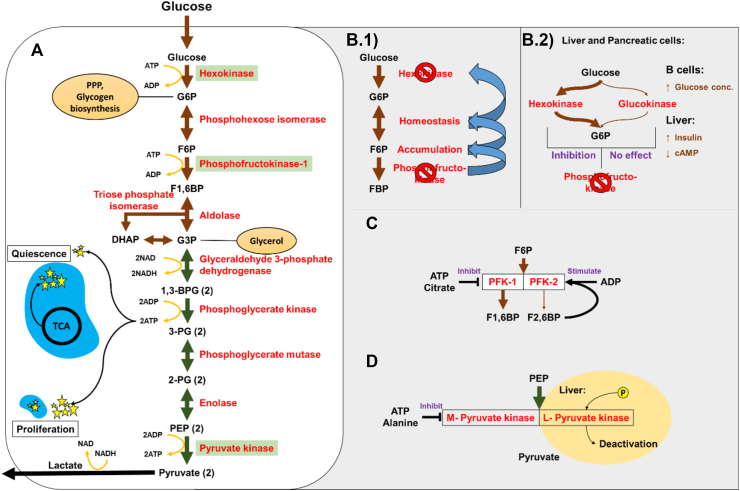
The initial five steps constitute the energy investment segment, where glucose undergoes phosphorylation and fragmentation into dual three-carbon molecules at the cost of two ATP molecules to prime subsequent energy extraction.
Extracellular glucose enters the cytoplasmic compartment and receives a phosphate group catalyzed by hexokinase (HK), generating glucose-6-phosphate (G6P). One ATP molecule is hydrolyzed to ADP in this irreversible reaction, locking glucose inside the cell membrane to prevent back-diffusion.
Phosphoglucose isomerase (PGI) rearranges the six-carbon ring structure of G6P into fructose-6-phosphate (F6P). This reversible structural adjustment modifies the carbon skeleton to enable downstream dual phosphorylation.
Phosphofructokinase-1 (PFK-1) catalyzes the attachment of a second phosphate group onto F6P to synthesize fructose-1,6-bisphosphate (F-1,6-BP). This reaction consumes the second ATP molecule and acts as the primary rate-limiting checkpoint of glycolysis.
Aldolase breaks the six-carbon F-1,6-BP into two distinct triose phosphate products: dihydroxyacetone phosphate (DHAP) and glyceraldehyde-3-phosphate (G3P). The two triose intermediates maintain a dynamic reversible equilibrium.
Triose phosphate isomerase fully converts DHAP into G3P, unifying all three-carbon glycolytic intermediates to proceed through the payoff stage uniformly.
Steps six through ten form the energy payoff segment, where stored chemical energy within triose phosphate molecules is released to synthesize ATP and regenerate NADH. Total energy output exceeds the two ATP molecules invested in the prior phase.
Glyceraldehyde-3-phosphate dehydrogenase (GAPDH) drives simultaneous oxidation and phosphorylation of G3P to produce 1,3-bisphosphoglycerate (1,3-BPG). Concurrently, free NAD+ accepts electrons to form NADH alongside hydrogen ion release.
Phosphoglycerate kinase (PGK) transfers the high-energy phosphate moiety from 1,3-BPG to ADP, yielding ATP and 3-phosphoglycerate (3-PG). This step marks the first net energy recovery for the cell.
Phosphoglycerate mutase shifts the phosphate group from carbon 3 to carbon 2 of the substrate, converting 3-PG into 2-phosphoglycerate (2-PG) through a reversible structural modification.
Enolase removes one molecule of water from 2-PG, elevating the molecular energy state to form phosphoenolpyruvate (PEP), a high-energy substrate ready for final ATP synthesis.
Pyruvate kinase catalyzes irreversible phosphate transfer from PEP to ADP, generating the end-product pyruvate plus a second ATP molecule. This catalytic step represents another key regulatory node controlling glycolytic flux.
Overall glycolytic output includes pyruvate, ATP and NADH. Each glucose molecule processed through the full pathway yields a net total of 2 ATP. This core energy metabolism pathway lays the biochemical foundation for subsequent aerobic mitochondrial oxidation or anaerobic fermentative reactions.
The metabolic fate of glycolytic end-products determines cellular energy strategies. Under normoxic conditions, pyruvate shuttles into mitochondria for complete oxidative breakdown to maximize ATP production. When oxygen is scarce, pyruvate converts into lactate to recycle NAD+, sustaining continuous glycolytic ATP generation in hypoxic microenvironments. In addition, glycolytic intermediates serve as building blocks for biosynthetic pathways that support cell proliferation and growth.
Glycolytic flux is precisely tuned by core catalytic proteins and multilayered regulatory signaling networks to match cellular energy demands under diverse physiological and pathological conditions.
Three irreversible rate-limiting enzymes dominate glycolytic metabolic flow by controlling substrate conversion efficiency: hexokinase (HK), phosphofructokinase-1 (PFK-1) and pyruvate kinase (PK).
Mediates initial glucose phosphorylation, irreversible step trapping glucose inside cells; abundant in muscle & brain, feedback inhibited by G6P.
Core rate-limiting enzyme; activated by AMP, suppressed by high ATP/citrate, responds to cellular energy status.
Catalyzes final ATP generation; inhibited by ATP, allosterically activated by F-1,6-BP to balance glycolytic rate.
Glycolytic regulation relies on coordinated crosstalk between multiple intracellular signaling cascades, balancing energy supply and consumption across distinct physiological and disease states.
Growth factor binding to cell-surface receptor tyrosine kinases (RTKs) initiates PI3K/Akt cascade activation, boosting cellular glucose uptake and glycolytic velocity by upregulating membrane glucose transporters GLUT1 and GLUT4. Activated Akt promotes transporter trafficking to the plasma membrane, enhancing extracellular glucose absorption.
The bifunctional regulatory enzyme PFKFB1 acts as a central insulin-responsive glycolytic switch. Insulin triggers dephosphorylation of inactive phosphorylated PFKFB1, restoring its kinase activity to amplify glycolytic flux and accelerate GLUT4 membrane translocation.
AMPK operates as a universal cellular energy sensor, activated when ATP reserves decline. Activated AMPK stimulates glycolysis by enhancing glucose uptake and upregulating key catalytic enzymes such as PFK-1.
HIF-1α stabilizes under hypoxia, heterodimerizes with HIF-1β to induce transcription of all core glycolytic enzymes, adapting cell metabolism to low-oxygen microenvironments.
Disordered glycolytic activity is tightly linked to the onset and progression of multiple human illnesses, predominantly malignant tumors, inherited metabolic disorders and degenerative neurological conditions.
Enhanced glycolytic flux constitutes a hallmark metabolic signature of tumor cells, conferring proliferative and survival advantages to neoplastic tissue. Cancer cells universally exhibit the Warburg effect, prioritizing glycolytic energy production even under sufficient oxygen concentrations to rapidly generate ATP and biosynthetic precursors required for fast cell division. Abnormal overexpression of glycolytic enzymes such as hexokinase and lactate dehydrogenase drives this metabolic shift.
Genetic loss-of-function mutations affecting glycolytic catalytic enzymes trigger red blood cell metabolic disorders, typically presenting as chronic hemolytic anemia or myopathy. These pathological states arise from impaired glucose processing within erythrocytes, compromising cellular structural integrity and survival.
Recent research confirms impaired glycolytic metabolism correlates with multiple degenerative brain diseases including Parkinson’s disease and Huntington’s disease. Functional glycolysis is essential to sustain normal neuronal electrical activity. Patient-derived disease models demonstrate reduced catalytic activity of core glycolytic enzymes, disrupting neuronal energy supply and triggering progressive nerve cell death.
The glycolysis pathway serves as a flexible, indispensable metabolic machinery maintaining cellular energy balance under diverse oxygen and nutritional environments. Beyond ATP generation, glycolysis delivers critical intermediate precursors required for anabolic biosynthetic pathways. Fine-tuned enzyme-mediated regulation enables cells to dynamically adjust glycolytic speed according to internal energy status and external oxygen availability, coordinating glycolysis with complementary mitochondrial metabolic networks.