
NK Cell Receptor | ELISA
1
Overview of Natural Killer Cells
Natural killer (NK) cells represent a vital subset of lymphocytes that constitute the body’s innate immune defense system. These large granular lymphocytes carry abundant cytoplasmic granules, sharing partial morphological features with monocytes. NK cells possess direct cytotoxic capability against abnormal target cells, serving critical roles in antiviral defense, immune surveillance and tumor suppression. In addition, they secrete functional cytokines such as IFN-γ to regulate hematopoiesis, inflammatory responses and systematic immune reactions.
NK cells feature a dual recognition system: they can detect target cells with absent or mutated MHC class I molecules to initiate killing signals, while binding intact MHC class I molecules transmits inhibitory signals. This dual-signal mode strictly balances and restricts NK cell activation to avoid accidental damage to healthy self-cells. The recognition and cytotoxic mechanisms of NK cells are entirely governed by diverse receptor molecules expressed on their membrane surface.
2
Classification of NK Cell Receptors
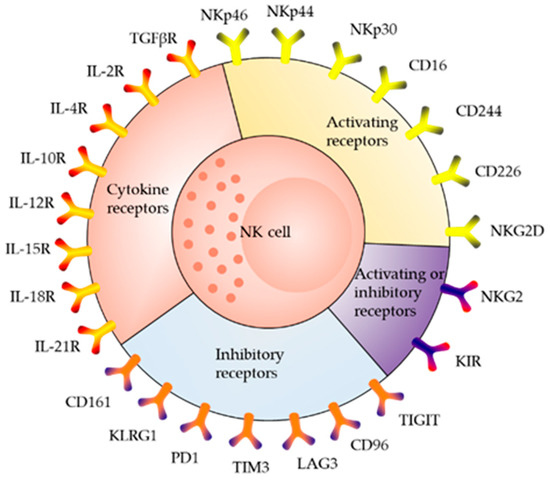
Surface receptors on NK cells (NKCR) fall into two primary functional groups: inhibitory killer immunoglobulin-like receptors (KIR) and killer activating receptors (KAR). NK cells also express abundant cytokine receptors to receive extracellular immune signals. This passage mainly elaborates on the functional characteristics of inhibitory and activating NK receptors.
3
NK Cell Inhibitory Receptors (KIR)
Upon binding autologous MHC-I ligands, NK inhibitory receptors transmit intracellular repressive signals to suppress the cell’s cytotoxic activity. All KIR molecules are categorized into the immunoglobulin superfamily (IgSF) or C-type lectin receptor family based on structural differences, and both families contain intracellular immunoreceptor tyrosine inhibitory motifs (ITIM).
After ligand engagement, ITIM domains relay inhibitory signaling cascades to block NK-mediated target cell lysis. For cells infected by viruses or transformed into tumor cells, MHC-I expression is often lost or downregulated; allogeneic and xenogeneic cell MHC molecules also fail to match self-KIR ligands. In these scenarios, inhibitory receptors cannot bind their corresponding ligands, removing the suppression signal and driving NK cell activation. Representative inhibitory receptors include CD161, KLRG1, PD1, TIM3, LAG3, CD96 and TIGIT.
After ligand engagement, ITIM domains relay inhibitory signaling cascades to block NK-mediated target cell lysis. For cells infected by viruses or transformed into tumor cells, MHC-I expression is often lost or downregulated; allogeneic and xenogeneic cell MHC molecules also fail to match self-KIR ligands. In these scenarios, inhibitory receptors cannot bind their corresponding ligands, removing the suppression signal and driving NK cell activation. Representative inhibitory receptors include CD161, KLRG1, PD1, TIM3, LAG3, CD96 and TIGIT.
4
NK Cell Activating Receptors (KAR)
NK activating receptors recognize carbohydrate epitopes and non-MHC surface ligands on abnormal target cells, delivering intracellular stimulatory signals to trigger cytotoxic effector functions. Similar to inhibitory receptors, activating receptors are divided into IgSF and C-type lectin families.
Most activating receptors rely on auxiliary adaptor proteins with immunoreceptor tyrosine activation motifs (ITAMs) to initiate downstream signaling cascades. Key activating receptors are the natural cytotoxic receptor (NCR) family: NKp30, NKp44 and NKp46. NKp30 specifically binds the tumor antigen B7-H6; NKp44 interacts with viral hemagglutinin, hemagglutinin neuraminidase and multiple tumor-associated surface molecules; NKp46 can restrict metastatic tumor proliferation in animal models. Fcγ-RIIIa (CD16) serves as another major activating receptor responsible for mediating antibody-dependent cellular cytotoxicity (ADCC).
Most activating receptors rely on auxiliary adaptor proteins with immunoreceptor tyrosine activation motifs (ITAMs) to initiate downstream signaling cascades. Key activating receptors are the natural cytotoxic receptor (NCR) family: NKp30, NKp44 and NKp46. NKp30 specifically binds the tumor antigen B7-H6; NKp44 interacts with viral hemagglutinin, hemagglutinin neuraminidase and multiple tumor-associated surface molecules; NKp46 can restrict metastatic tumor proliferation in animal models. Fcγ-RIIIa (CD16) serves as another major activating receptor responsible for mediating antibody-dependent cellular cytotoxicity (ADCC).