Table 1. The family of coagulation factors
| Number | Name / Alias | Chemical Essence | Synthetic site | Involving pathway | Function |
|---|---|---|---|---|---|
| I | Fibrinogen | glycoprotein | Liver | Final common pathway | Forms clot (fibrin) |
| II | Prothrombin | glycoprotein | Liver | Final common pathway | Its active form (IIa) activates I, V, X, VII, VIII, XI, XIII, protein C, platelets |
| III | Tissue factor | glycoprotein | Tissue Endotheliocyte monocyte | Tissue factor pathway | Co-factor of VIIa (formerly known as factor III) |
| IV | Calcium | calcium ion | - | Three pathways | Required for coagulation factors to bind to phospholipid (formerly known as factor IV) |
| V | proaccelerin, labile factor | glycoprotein | Liver | Final common pathway | Co-factor of X with which it forms the prothrombinase complex |
| VII | stable factor, proconvertin | glycoprotein | Liver | Tissue factor pathway | Activates IX, X |
| VIII | Antihemophilic factor A | glycoprotein | Liver | Contact activation pathway | Co-factor of IX with which it forms the tenase complex |
| IX | Antihemophilic factor B | glycoprotein | Liver | Contact activation pathway | Activates X; forms tenase complex with factor VIII |
| X | Stuart-Prower factor | glycoprotein | Liver | Final common pathway | Activates II; forms prothrombinase complex with factor V |
| XI | plasma thromboplastin antecedent | glycoprotein | Liver | Contact activation pathway | Activates IX |
| XII | Hageman factor | glycoprotein | Liver | Contact activation pathway | Activates factor XI, VII and prekallikrein |
| XIII | fibrin-stabilizing factor | glycoprotein | Liver, platelet | Final common pathway | Crosslinks fibrin |
TF initiates the activation of factor VIIa, factor Xa, and thrombin (IIa), which in turn trigger platelet activation and PAR-mediated signaling. This leads to increased cytokine release, upregulated adhesion molecules such as ICAM-1 and VCAM-1, and reduced expression of vasculoprotective molecules such as thrombomodulin. The release of P-selectin, vWF, PF4, and CD40L further promotes platelet and leukocyte recruitment and the formation of neutrophil extracellular traps (NETs). Thrombin also contributes to complement activation, generating C5a and C5b-9, which amplify inflammation and coagulation.
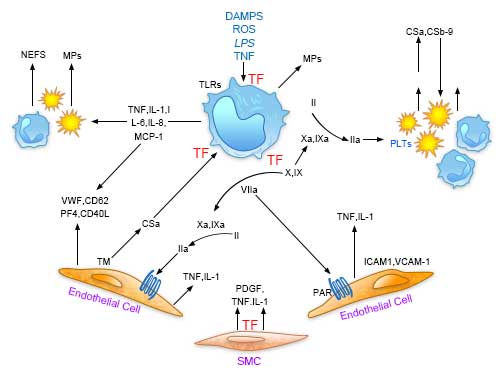
Fig. 1. Central role of tissue factor (TF) in the interplay between coagulation and inflammation.
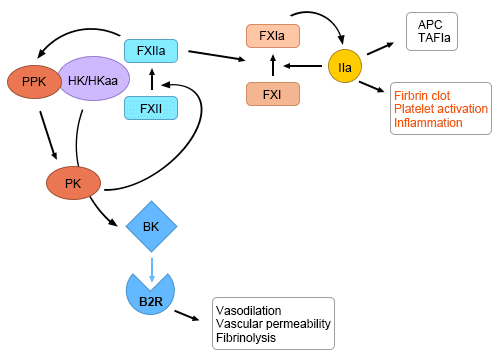
FXIIa also activates factor XI in the coagulation cascade, promoting additional thrombin generation. Free thrombin drives both coagulation and inflammation, while thrombin bound to thrombomodulin promotes the production of activated protein C (APC) and TAFIa. C1-inhibitor serves as a major negative regulator of FXIIa, FXIa, and kallikrein.