
Ras signaling pathway | ELISA
1
What Is Ras?
Ras, the abbreviation for rat sarcoma, is a small monomeric GTP‑binding protein that possesses low intrinsic GTPase activity. This protein is predominantly anchored to the cytoplasmic face of the cell plasma membrane, and it remains functionally quiescent when coupled to GDP molecules.
2
What Is Ras Signaling Pathway?
Within the Ras signal transduction cascade, once Ras becomes activated, it initiates phosphorylation cascades targeting its downstream substrate molecules, coordinating a wide array of secondary signaling axes that govern core biological activities of cells.
3
Core Biological Roles of the Ras Signaling Pathway
The Ras signaling cascade participates in regulating numerous fundamental cellular events, including cell growth and survival, cell fate differentiation, programmed cell death (apoptosis), cytoskeleton dynamics, as well as intracellular protein trafficking and secretory activities.
4
Activation and Signaling Cascade of the Ras Pathway
Under resting physiological conditions, Ras forms a complex with GDP and stays biologically inactive. Ras switches to its active conformation upon dissociating from GDP and associating with GTP. Guanine nucleotide exchange factors (GEFs), with Sos serving as a typical representative, act as upstream triggers to drive Ras activation. Conversely, GTPase‑activating proteins (GAPs) accelerate the breakdown of GTP bound to Ras, converting active Ras‑GTP back to the dormant Ras‑GDP complex and terminating Ras‑mediated signaling.
GEFs facilitate the dissociation of GDP from GDP‑bound Ras. Since Sos lacks an SH2 structural domain, it cannot directly interact with cell surface receptors. Instead, the bridging adaptor protein Grb2 attaches to phosphorylated tyrosine residues on activated receptors via its SH2 domain, then recruits Sos through its SH3 motifs. The recruited Sos subsequently interacts with membrane‑tethered Ras to trigger Ras activation. Alternatively, growth factors including EGF, PDGF and FGF bind and activate receptor protein tyrosine kinases (RPTKs), which also initiate the upstream signaling leading to Ras activation.
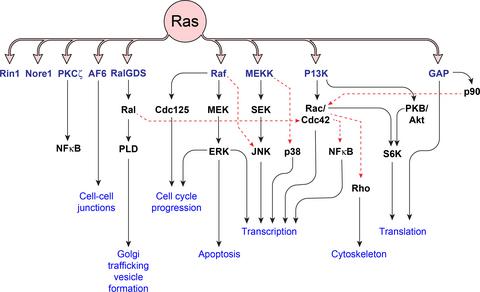
Activated Ras physically interacts with and stimulates the kinase activity of Raf. The activated Raf protein further phosphorylates and activates MEK1/2. MEK1/2 then mediates the phosphorylation of ERK1/2 to switch on these effector kinases. Phosphorylated ERK1/2 translocate into the cell nucleus and upregulate the transcription of multiple downstream target genes such as Elk‑1 and eIF4E, ultimately driving cell proliferation and differentiation processes.
Moreover, activated Ras can directly engage and activate PI3K. Catalytically active PI3K converts membrane lipid PIP2 into the second messenger PIP3. Accumulated PIP3 recruits and activates PDK, which in turn phosphorylates and activates Akt, launching the PI3K‑Akt signaling branch that modulates cell proliferative capacity.
RalGDS promotes the release of GDP from Ras homologous small GTPases RalA and RalB, enabling these two proteins to bind GTP and turn active. RalBP suppresses the activity of GTP‑bound Rac and Cdc42, thereby modulating actin cytoskeleton rearrangement. Additionally, signaling through Rac and Cdc42 activates the transcription factor NF‑κβ, which elevates the expression of anti‑apoptotic proteins to counteract cell death signals.
GEFs facilitate the dissociation of GDP from GDP‑bound Ras. Since Sos lacks an SH2 structural domain, it cannot directly interact with cell surface receptors. Instead, the bridging adaptor protein Grb2 attaches to phosphorylated tyrosine residues on activated receptors via its SH2 domain, then recruits Sos through its SH3 motifs. The recruited Sos subsequently interacts with membrane‑tethered Ras to trigger Ras activation. Alternatively, growth factors including EGF, PDGF and FGF bind and activate receptor protein tyrosine kinases (RPTKs), which also initiate the upstream signaling leading to Ras activation.
Activated Ras physically interacts with and stimulates the kinase activity of Raf. The activated Raf protein further phosphorylates and activates MEK1/2. MEK1/2 then mediates the phosphorylation of ERK1/2 to switch on these effector kinases. Phosphorylated ERK1/2 translocate into the cell nucleus and upregulate the transcription of multiple downstream target genes such as Elk‑1 and eIF4E, ultimately driving cell proliferation and differentiation processes.
Moreover, activated Ras can directly engage and activate PI3K. Catalytically active PI3K converts membrane lipid PIP2 into the second messenger PIP3. Accumulated PIP3 recruits and activates PDK, which in turn phosphorylates and activates Akt, launching the PI3K‑Akt signaling branch that modulates cell proliferative capacity.
RalGDS promotes the release of GDP from Ras homologous small GTPases RalA and RalB, enabling these two proteins to bind GTP and turn active. RalBP suppresses the activity of GTP‑bound Rac and Cdc42, thereby modulating actin cytoskeleton rearrangement. Additionally, signaling through Rac and Cdc42 activates the transcription factor NF‑κβ, which elevates the expression of anti‑apoptotic proteins to counteract cell death signals.
5
Aberrant Ras Signaling in Human Diseases
Oncogenic mutations of the Ras gene are widely detected in various malignant tumors; the most prevalent alterations involve amino acid substitutions at glycine residues 12 and 13, or glutamine residue 61. Mutant Ras proteins exhibit severely impaired GTP hydrolysis capability even in the presence of GAP molecules. Without GAP‑assisted catalysis, GTP breakdown fully relies on Ras’s weak intrinsic GTPase activity, drastically extending the lifespan of Ras‑GTP complexes. Persistent Ras activation leads to constitutive hyperactivation of the Ras‑Raf‑MEK‑ERK signaling axis, which drives uncontrolled cell division and facilitates tumor formation and progression.
Key note:Ras‑GTP = active state; Ras‑GDP = inactive state