
Initial research clues regarding histone ubiquitylation emerged back in 1975, when scientists successfully identified ubiquitin molecules bound to histone H2A within calf thymus chromatin nucleosomes. Major research breakthroughs in the early 2000s enabled researchers to pinpoint distinct catalytic enzymes responsible for histone ubiquitin conjugation. Subsequent investigations gradually uncovered the diverse biological functions carried out by histone ubiquitylation modifications.
Histone ubiquitylation refers to the biochemical modification process where a 76-amino-acid ubiquitin (Ub) polypeptide chain covalently attaches to lysine residues on histone proteins. This modification is split into two primary subtypes: histone mono-ubiquitylation and histone poly-ubiquitylation, categorized by the quantity of conjugated ubiquitin moieties. Core histones H2A and H2B are the predominant substrates for mono-ubiquitylation, a reversible modification that shifts nucleosome molecular weight and modulates chromatin dynamic states. In contrast, histone poly-ubiquitylation forms permanent degradation signals that guide target proteins toward proteasome-dependent breakdown.
Within most higher eukaryotic organisms, ubiquitinated H2A accounts for 5%–15% of the total cellular H2A pool, while the ubiquitylation level of H2B sits at merely 1%–1.5%. In budding yeast Saccharomyces cerevisiae, roughly 10% of H2B carries ubiquitin modifications, yet detectable ubiquitinated H2A is absent in this species.
The dominant ubiquitylation residue on histone H2A is lysine 119 (annotated as H2AK119ub1). For H2B, the key modification sites differ across species: lysine 123 (H2BK123ub1) in yeast and lysine 120 (H2BK120ub1) in mammalian cells. Chromatin immunoprecipitation (ChIP) experimental data demonstrate that monoubiquitinated H2A mainly accumulates at genomic satellite regions, whereas H2Bub signals distribute across the coding regions of actively transcribed genes.
Apart from H2A and H2B, ubiquitin conjugation has also been validated on core histones H3, H4, as well as linker histone H1. One representative example: upon UV radiation exposure, the CUL4-DDB-RBX1 ubiquitin ligase complex catalyzes polyubiquitination of H3 and H4 inside living cells.
Ubiquitin first undergoes ATP-dependent activation by E1 activating enzymes, creating a thioester linkage between ubiquitin’s C-terminal glycine and the catalytic cysteine residue of E1. The activated ubiquitin group is then transferred to E2 conjugating enzymes via another thioester bond. Finally, E2 forms a complex with E3 ubiquitin ligase, which facilitates stable covalent attachment of ubiquitin to the target lysine residue on histone substrates. The core function of E3 ligases is to orient the E2-ubiquitin complex close to the modification site on histones.
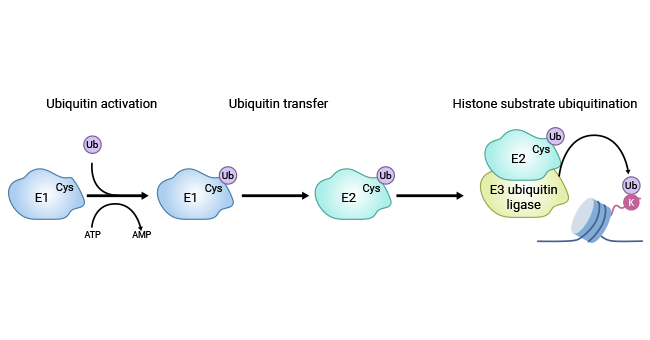
Figure 1. Schematic workflow illustrating histone mono-ubiquitylation catalytic steps.
Histone ubiquitylation proceeds through coordinated sequential reactions mediated by three enzyme families: E1 activating enzymes, E2 conjugating enzymes, and E3 ubiquitin ligases. These coordinated reactions ultimately link ubiquitin (Ub) to lysine (Lys) residues on histone polypeptides.
This histone modification pathway is fully reversible. Deubiquitinases (DUBs) reverse ubiquitylation by cleaving ubiquitin chains off modified histone lysine sites.
| Enzyme | Species | Histone specificity | Enzymatic activity | Role in transcription |
|---|---|---|---|---|
| RING1A/RING1B/BMI1 | Human | H2A | E3 | Repression |
| 2A-HUB | Human | H2A | E3 | Repression |
| BRCA1/BARD1 | Human | H2A | E3 | Repression |
| UbcH5c | Human | H2A | E2 | N/A |
| Bre1 | Yeast | H2B | E3 | Activation |
| Rad6 | Yeast | H2B | E2 | Activation |
| RNF20/RNF40 | Human | H2B | E3 | Activation |
| RAD6A/RAD6B | Human | H2B | E2 | Activation |
| UbcH6 | Human | H2B | E2 | Activation |
| USP16 | Human | H2A | DUB | Activation |
| USP21 | Human | H2A | DUB | Activation |
| 2A-DUB | Human | H2A | DUB | Activation |
| BAP1 | Human/Drosophila | H2A | DUB | Activation |
| Ubp8 | Yeast | H2B | DUB | Activation |
| Ubp10 | Yeast | H2B | DUB | Repression |
| Ubp7 | Drosophila | H2B | DUB | Repression |
| SCNY | Drosophila | H2B | DUB | Repression |
| UBP12/UBP46 | Xenopus | H2A H2B | DUB | Activation |
| USP3 | Human | H2A H2B | DUB | N/A |
| USP22 | Human | H2A H2B | DUB | Activation |
| BAP1 | Human/Drosophila | H2A | DUB | Activation |
| Ubp8 | Yeast | H2B | DUB | Activation |
Unlike other histone modification reader proteins, no conserved structural domain or shared motif exists among protein factors that recognize ubiquitylated histone marks.
| Modification Mark | Associated Reader Proteins |
|---|---|
| H2AK119ub1 | PRC1, PRC2, RSF1, DNMT3A, ZRF1 |
| H2AK13/15ub1 | 53BP1, RNF169 , RAD18, BARD1 |
| H2AK127/129ub1 | SMARCAD1, USP48 |
| H2BK120ub1 | Dot1L, COMPASS, MLL complexes, FACT, SWI/SNF, Chd1 |
| H2BK18/23ub1 | DNMT1 |
| H3K14ub1 | Clr4/SUV39H1 |
| H3K23/36/37ub1 | Gcn5 |
4. Function of Histone Ubiquitylation
As the most abundant class of ubiquitin-modified proteins in eukaryotic nuclei, histones’ ubiquitylation modifications exert essential regulatory effects on nearly all DNA-dependent biological processes, including transcription initiation and elongation, chromatin structural maintenance, DNA replication, and DNA damage repair. The distinct functional outcomes of this modification mainly rely on chromatin regulatory factors selectively binding to specific ubiquitylated histone residues.
Histone mono-ubiquitylation can either stimulate or suppress gene transcription, whereas polyubiquitin chains primarily label histones for proteasome-mediated proteolysis.
H2AK119ub1 mediates transcriptional silencing at tissue-specific gene loci, the inactive female X chromosome, and genomic regions with DNA damage lesions. This H2A ubiquitylation mark also modulates linker histone H1 binding to nucleosomes, sustains Polycomb group-mediated gene silencing, and participates in X chromosome inactivation in female mammals.
H2Bub1 regulates transcriptional initiation and extension, cellular DNA damage response (DDR), as well as pluripotency maintenance of stem cells. Both yeast and human cell studies confirm that H2Bub1 acts as an essential prerequisite for H3K4 and H3K79 methylation events. Experimental evidence proves H2Bub1 directly enhances the catalytic activity of DOT1L methyltransferase, thereby boosting H3K79 methylation levels across yeast and human cellular models.
Histone ubiquitylation also takes part in spermatogenesis and plays a critical role in nucleosome clearance during sperm cell maturation.
The regulatory crosstalk network connecting histone ubiquitylation and other histone post-translational modifications forms an intricate control system that balances chromatin dynamics and global gene expression profiles.
Multiple studies confirm histone lysine methylation undergoes reciprocal regulation with histone ubiquitylation or its related catalytic enzymes. Monoubiquitinated H2A recruits PRC2 complexes to drive H3K27 methylation. This methyl mark further recruits SETDB1 to catalyze H3K9 trimethylation, which anchors chromatin compaction proteins such as HP1. Trimethylated H3K27 then recruits additional PRC1 complexes, establishing stable long-range repressive chromatin signals dependent on H2A ubiquitylation. On the other hand, H2B monoubiquitylation activates DOT1L to methylate H3K79, which subsequently promotes MLL-dependent H3K4 methylation and recruits multiple transcriptional co-activators.
Ubiquitylation also cross-regulates histone lysine acetylation during the DNA damage response. Silencing lysine acetyltransferases KAT5 (TIP60) or PCAF reduces H2BK120 acetylation (H2BK120ac) while elevating H2BK120 ubiquitylation after DNA damage stimulation. EP300 acetylates the H3K9me2 demethylase JMJD1A at lysine 421; this acetylation modification blocks STUB1-induced polyubiquitination and stabilizes intracellular JMJD1A protein abundance. H2B monoubiquitylation also interacts with H3 methylation marks to facilitate gene transcription and maintain telomeric silencing status.
Interactions between histone ubiquitylation and phosphorylation also participate in chromatin homeostasis control. Activated EGFR signaling triggers RNF8-UBE2L6 to assemble K48-linked polyubiquitin chains on H3K4, which targets histone H3 for proteasomal degradation. Mutating H3.3 threonine 11 to alanine (H3.3T11A) abolishes both H3.3T11 phosphorylation and concurrent ubiquitylation. Histone phosphorylation and ubiquitylation cooperate synergistically to transmit DNA damage signals triggered by ionizing radiation (IR).
Abnormal activation or inhibition of histone ubiquitylation/deubiquitylation pathways is recognized as a pathogenic driver for numerous human illnesses, covering neurological developmental disorders and malignant tumors.
Genetic mutations disrupting proteins controlling H2Aub levels correlate with multiple congenital syndromes and brain developmental defects. For instance, loss-of-function AUTS2 variants link to autism spectrum disorder and intellectual impairment. PHC1 protein insufficiency leads to autosomal recessive primary microcephaly and other cerebral developmental disorders. PHC1 gene mutations disrupt physiological H2A ubiquitylation, hinder normal cell cycle progression, and impair cellular DNA damage repair capacity.
Complete PRC1 protein deletion is embryonically lethal in mammals. Mutations weakening PRC1 catalytic activity cause microcephaly and cognitive dysfunction. Dysregulated PRC1 activity also drives tumor formation in various organs, including brain, liver, colon, breast, lung, prostate, and lymphatic tissues.
Aberrant H2Bub1 mono-ubiquitylation is closely associated with malignant transformation. The RNF20/40 complex frequently loses function in primary tumors including colorectal, breast, ovarian, prostate, and lung carcinoma. Low cellular H2Bub1 levels consistently correlate with poor clinical prognosis in cancer patients.
Gene amplification or overexpression of RING and BMI1 proteins raises global H2Aub abundance and accelerates tumor progression. Cancer-associated mutations within BAP1’s UCH, CTD, and NLS functional domains eliminate its deubiquitinase activity toward H2Aub, facilitating tumor development and progression.