
VEGF signaling pathway | ELISA
1
Definition of VEGF Signaling Pathway
Vascular endothelial growth factor (VEGF), also known as vascular permeability factor (VPF), is a dimeric glycoprotein ligand that activates a complex signal transduction network responsible for new blood vessel formation. Once VEGF binds to cell surface VEGF receptors (VEGFRs), the intracellular tyrosine kinase domains become activated, triggering sequential signaling events that regulate vasculogenesis and angiogenesis processes.
2
Core Biological Functions of VEGF Signaling Pathway
This signaling cascade plays a critical regulatory role in two key vascular processes: vasculogenesis, the de novo generation of blood vessels, and angiogenesis, the sprouting of new vessels from existing vasculature. Angiogenic activity is involved in a wide range of physiological and pathological states, and the VEGF pathway carries dual regulatory effects within human bodies.
On the physiological side, VEGF signaling facilitates bone remodeling, hematopoietic cell generation, wound healing and embryonic tissue development. In contrast, sustained overactivation of VEGF signaling accelerates malignant tumor progression. According to Judah Folkman’s tumor angiogenesis theory, solid tumors will upregulate VEGF expression once they grow beyond a tiny volume to induce neovascularization, which supplies sufficient oxygen and nutrients to sustain continuous tumor proliferation.
On the physiological side, VEGF signaling facilitates bone remodeling, hematopoietic cell generation, wound healing and embryonic tissue development. In contrast, sustained overactivation of VEGF signaling accelerates malignant tumor progression. According to Judah Folkman’s tumor angiogenesis theory, solid tumors will upregulate VEGF expression once they grow beyond a tiny volume to induce neovascularization, which supplies sufficient oxygen and nutrients to sustain continuous tumor proliferation.
3
Classification of VEGF Ligands and VEGFR Receptors
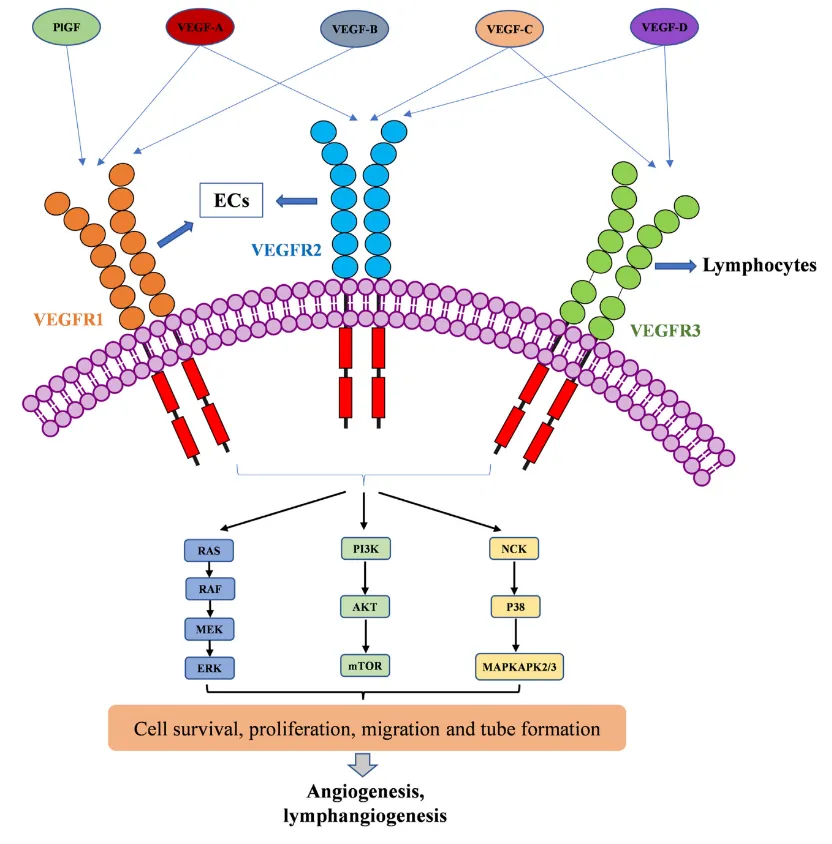
Mammalian organisms contain a VEGF ligand superfamily consisting of VEGFA, VEGFB, VEGFC, VEGFD, VEGFE and placental growth factor (PGF). VEGFA is the most abundant subtype and is generally referred to simply as VEGF. Three distinct VEGFR subtypes have been identified: VEGFR-1, VEGFR-2 and VEGFR-3. All three subtypes belong to the transmembrane tyrosine kinase receptor family, featuring an extracellular ligand-binding domain, a single transmembrane helix and an intracellular C-terminal kinase segment. Multiple experimental studies have proven that VEGFR-2 acts as the primary signal transducer mediating endothelial cell responses induced by VEGF.
VEGFA: The classic VEGF subtype capable of binding both VEGFR-1 and VEGFR-2. It promotes angiogenic sprouting, boosts endothelial cell migration and proliferation, upregulates matrix metalloproteinase and αvβ3 integrin activity, and supports the formation of vascular luminal structures.
VEGFB: Selectively binds VEGFR-1 and mainly controls angiogenesis during embryonic development.
VEGFC: Interacts with VEGFR-2 and VEGFR-3 to initiate lymphangiogenesis, the formation of lymphatic vessels.
VEGFD: Combines with VEGFR-2 and VEGFR-3, and is essential for the maturation of lymphatic networks surrounding lung bronchioles.
VEGFE: Specifically binds VEGFR-2 to trigger partial angiogenic responses.
PGF: A specific binding partner of VEGFR-1, required for physiological vasculogenesis and angiogenesis triggered by ischemia, inflammatory lesions, tissue injury and tumor lesions.
VEGFA: The classic VEGF subtype capable of binding both VEGFR-1 and VEGFR-2. It promotes angiogenic sprouting, boosts endothelial cell migration and proliferation, upregulates matrix metalloproteinase and αvβ3 integrin activity, and supports the formation of vascular luminal structures.
VEGFB: Selectively binds VEGFR-1 and mainly controls angiogenesis during embryonic development.
VEGFC: Interacts with VEGFR-2 and VEGFR-3 to initiate lymphangiogenesis, the formation of lymphatic vessels.
VEGFD: Combines with VEGFR-2 and VEGFR-3, and is essential for the maturation of lymphatic networks surrounding lung bronchioles.
VEGFE: Specifically binds VEGFR-2 to trigger partial angiogenic responses.
PGF: A specific binding partner of VEGFR-1, required for physiological vasculogenesis and angiogenesis triggered by ischemia, inflammatory lesions, tissue injury and tumor lesions.
4
Molecular Transduction Mechanism of VEGF Signaling Pathway
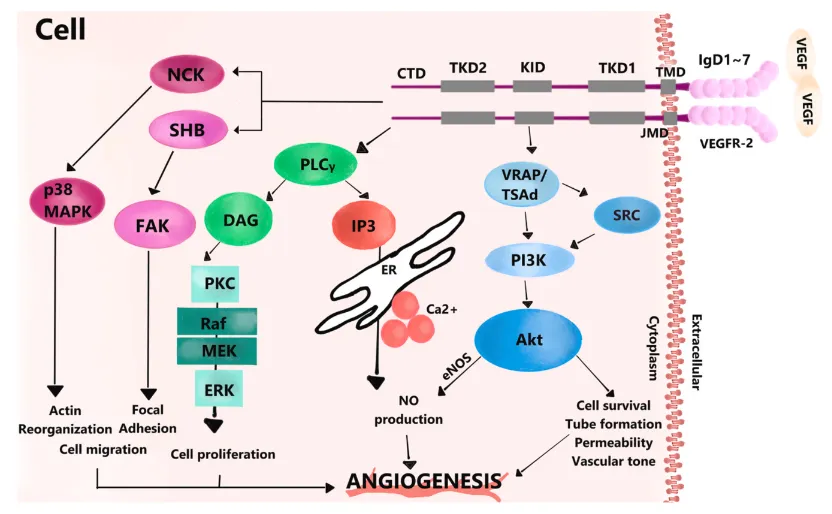
As shown in pathway schematic diagrams, ligand-receptor binding transiently activates the intrinsic kinase domains of receptors, enabling them to recruit cytoplasmic tyrosine or serine/threonine kinases. This sequential activation propagates downstream signaling cascades and generates various secondary messenger molecules. These intracellular signals eventually translocate into the cell nucleus to modify the transcription levels of target genes, thereby regulating endothelial cell proliferation, survival, migration and vascular permeability.
Binding of VEGF induces VEGFR-2 homodimerization, which sequentially activates PLCγ and the PKC-Raf-MEK-MAPK cascade to facilitate DNA replication and endothelial cell proliferation. Meanwhile, activated Src kinase initiates the PI3K-Akt signaling branch, which transmits anti-apoptotic signals to sustain endothelial cell survival. Src-dependent signaling also promotes the degradation of vascular basement membranes and greatly increases tissue vascular permeability. Meanwhile, CDC42 and p38 MAPK signaling pathways get activated; phosphorylated p38 MAPK remodels intracellular actin cytoskeletons to facilitate endothelial cell migration.
Binding of VEGF induces VEGFR-2 homodimerization, which sequentially activates PLCγ and the PKC-Raf-MEK-MAPK cascade to facilitate DNA replication and endothelial cell proliferation. Meanwhile, activated Src kinase initiates the PI3K-Akt signaling branch, which transmits anti-apoptotic signals to sustain endothelial cell survival. Src-dependent signaling also promotes the degradation of vascular basement membranes and greatly increases tissue vascular permeability. Meanwhile, CDC42 and p38 MAPK signaling pathways get activated; phosphorylated p38 MAPK remodels intracellular actin cytoskeletons to facilitate endothelial cell migration.
5
Diseases Linked to Abnormal VEGF Signaling
Overexpression of VEGF is associated with a wide range of clinical disorders, including multiple solid tumors, breast cancer, glioblastoma multiforme (GBM), melanoma and tissue damage caused by hypoxia. Solid tumors cannot grow continuously without adequate blood supply, so they upregulate VEGF expression to induce neovascularization, which delivers nutrients and provides channels for tumor metastasis.
6
Therapeutic VEGF Pathway Inhibitors
Since the binding interaction between VEGF and VEGFR initiates all downstream enzymatic signaling cascades, blocking this ligand-receptor binding can effectively suppress the activity of the VEGF pathway. VEGF inhibitory drugs include neutralizing monoclonal antibodies, while VEGFR-targeted drugs are small-molecule tyrosine kinase inhibitors. Multiple clinically approved therapeutic agents such as aflibercept, bevacizumab, ranibizumab and pegaptanib inhibit VEGF signaling to slow down or reverse the progression of angiogenic diseases.
Key note:VEGFR-2 serves as the primary functional receptor mediating most angiogenic responses triggered by VEGF ligands.