
Within the field of pharmacokinetics, tracking the transport and transformation of therapeutic substances inside living organisms involves intricate biological processes. Compartmental modeling acts as a core analytical tool that simplifies such complex physiological behaviors, enabling scientists to visualize, quantify and forecast how drugs distribute, metabolize and eliminate across distinct bodily tissues.
This paper systematically introduces the core concepts of pharmacokinetic compartmental models, sorts out mainstream model classifications, elaborates the design logic behind this analytical framework, and summarizes its core strengths, inherent drawbacks as well as diversified research and clinical applications.
Pharmacokinetic compartmental modeling refers to a set of quantitative mathematical algorithms used to depict the full ADME (absorption, distribution, metabolism, excretion) process of pharmaceutical compounds inside organisms. This analytical method abstracts the human body into several virtual independent units by grouping organs and body fluids sharing consistent pharmacokinetic properties. Each abstract compartment simulates the transfer rate and equilibrium state of target drugs, allowing precise prediction of drug concentration changes based on varied compartment structural layouts.
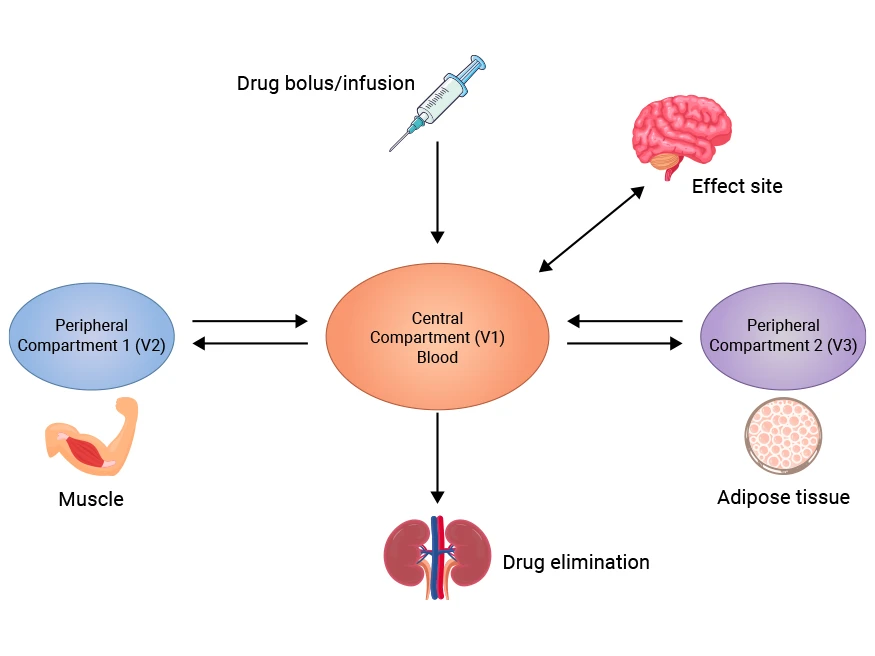
Widely adopted compartment frameworks include one-compartment, two-compartment, three-compartment and physiologically-based pharmacokinetic (PBPK models). Each type differs in structural complexity and applicable scenarios, matching the distinct metabolic patterns of different therapeutic agents.
| Compartment Model Type | Core Definition | Key Characteristics | Advantages | Limitations | Suitable Drug Categories |
|---|---|---|---|---|---|
| One-Compartment Model | Abstracts the entire human body as a single, homogeneous virtual compartment, assuming that the administered drug is instantaneously and uniformly distributed across all bodily tissues and fluids after administration. | 1. Extreme simplification of physiological differences between tissues 2. Drug elimination process strictly follows first-order kinetic rules 3. No distinction between tissue distribution and elimination phases | 1. Simple mathematical derivation and low computational threshold, easy to learn and apply 2. Enables rapid preliminary screening and evaluation of basic pharmacokinetic parameters of candidate drugs 3. Minimal requirements for experimental sampling data | 1. Deviates significantly from the real physiological differences in drug distribution among different tissues, with low simulation accuracy 2. Very limited applicable range, only suitable for drugs with negligible tissue distribution lag 3. Cannot describe the multi-phase kinetic characteristics of drugs in vivo | Rapid-onset pharmaceutical preparations, partial systemic antibiotics, and short-acting analgesic medicines |
| Two-Compartment Model | Divides the human body into two independent virtual compartments: the central compartment (composed of blood, heart, liver, kidneys and other highly perfused visceral organs) and the peripheral compartment (composed of low-blood-flow tissues such as skeletal muscle, adipose tissue and skin). | 1. Clearly separates the rapid drug distribution phase and the slow elimination phase 2. Requires solving and fitting the volume of distribution and elimination rate constants of two independent compartments 3. Both drug distribution and clearance processes comply with first-order kinetic rules | 1. More consistent with the real rules of drug transport and distribution in the human body, with significantly improved simulation accuracy 2. Covers the metabolic characteristics of most common pharmaceutical varieties on the market 3. Balances model complexity and practical applicability | 1. Increased modeling and parameter fitting workload, requiring certain mathematical and pharmacokinetic expertise 2. Demands multiple serial blood sampling time points to accurately fit model parameters 3. Cannot describe the distribution differences of drugs in multiple peripheral tissues with significant perfusion gaps | Systemic antiviral preparations, partial targeted antitumor drugs, long-acting sustained-release pharmaceutical agents, and most oral solid preparations |
| Three-Compartment Model | Further subdivides the human body into three independent virtual compartments: the plasma central compartment, the highly perfused peripheral compartment, and the low-perfusion deep tissue compartment, achieving more refined simulation of drug distribution in different tissues. | 1. Multi-layered tissue distribution simulation, distinguishing plasma, visceral tissues, muscle/fat deep tissues 2. Accurately describes the multi-stage dynamic transfer process of drugs between different tissues 3. Captures the slow distribution and accumulation characteristics of drugs in deep tissues | 1. Extremely high simulation accuracy for complex pharmacokinetic processes with multi-tissue differential distribution 2. Strong adaptability to drugs with significant concentration gaps among multiple physiological tissues 3. Can describe the full kinetic process of drug absorption, distribution, metabolism and excretion more comprehensively | 1. Very complex model construction and parameter calibration workflow, requiring advanced professional knowledge 2. Demands a large amount of serial experimental sampling data to support stable parameter fitting 3. High computational resource consumption, not suitable for rapid preliminary drug screening | Therapeutic agents with significant multi-tissue differential distribution characteristics, lipophilic drugs with deep tissue accumulation, and drugs with long elimination half-lives |
| Physiologically-Based Pharmacokinetic (PBPK) Model | Constructs multiple interconnected virtual compartments that strictly correspond to the actual independent organs and tissues of the human body, built upon authentic anatomical, physiological and biochemical datasets. | 1. Strictly physiologically driven, with model structure completely mapped to real human anatomical structure 2. Describes the full ADME process of drugs through a system of coupled differential equations 3. Can integrate individual physiological differences to achieve personalized simulation | 1. Extremely high flexibility, supporting simulation of drug pharmacokinetics in different populations, individuals and physiological/pathological conditions 2. Strong mechanism interpretability, can reveal the intrinsic mechanism of drug metabolic changes 3. Widely used in new drug R&D, preclinical-clinical extrapolation, and personalized dosage prediction | 1. Requires advanced mathematics, pharmacology and biomedical expertise for model construction, verification and optimization 2. Relies on powerful computing hardware and massive high-quality input data 3. Long model construction cycle, not suitable for rapid preliminary evaluation of large numbers of candidate compounds | Novel drug candidates with unclear metabolic pathways, complex multi-target pharmaceutical agents, drugs with high inter-individual metabolic differences, and biological products such as monoclonal antibodies |
Pharmacokinetic compartmental modeling is developed to convert messy in-vivo drug ADME physiological processes into standardized, computable quantitative systems.
Such modeling systems supply solid theoretical foundations and quantitative analysis tools for new pharmaceutical research, and occupy an irreplaceable position in preclinical drug screening and clinical medication guidance. By continuously optimizing compartment model structures, researchers can more clearly interpret the metabolic rules of candidate drugs and accelerate the research progress of novel therapeutics as well as individualized clinical treatment schemes.
In PK experiments and clinical trial design, compartment models help investigators determine optimal administration dosages to maximize curative effects while lowering adverse reaction risks. Meanwhile, these analytical frameworks support quantitative evaluation of drug bioavailability, clearance rate and therapeutic window indexes.
Compartmental analysis delivers remarkable research value for pharmaceutical and clinical study, yet the theoretical assumptions and computational logic embedded also bring certain inherent constraints. Researchers need to comprehensively weigh these pros and cons before selecting modeling methods to guarantee reliable and credible analysis outcomes.
Compartmental analytical frameworks are extensively applied across the full pharmaceutical research chain, covering preclinical compound screening, clinical trial design and personalized clinical medication, greatly boosting the efficiency and precision of pharmaceutical R&D and clinical practice.
Models precisely predict dynamic drug concentration changes inside organisms. Researchers can analyze inter-compartment distribution characteristics to adjust administration doses and frequency, balancing therapeutic efficacy and toxic side effects.
In new drug development stages, compartment models are adopted to evaluate the influence of different delivery modes, doses and administration intervals on blood drug levels, helping set scientific trial parameters and lifting trial success probability.
Simulate the metabolic interference between co-administered compounds, forecast efficacy decline or toxicity enhancement risks under combined medication, providing reference for polypharmacy safety evaluation.
Combined with patients’ unique physiological and metabolic indicators, clinicians utilize compartment simulation results to design exclusive administration plans, raising curative effects and reducing adverse reaction incidence.
Simulate in-vivo metabolism and excretion processes of candidate compounds to predict potential organ toxic risks, screen high-safety drug molecules and shorten R&D cycles.
Construct targeted sub-compartment structures to dissect drug metabolic transformation routes, identify active/inactive metabolites and offer guidance for lead compound structural optimization.
Pharmaceutical enterprises need to submit complete pharmacokinetic data to drug regulatory authorities such as the FDA during new drug declaration. Compartment modeling analysis provides standardized quantitative evidence to satisfy official evaluation standards.
Compartmental modeling acts as an indispensable analytical tool in modern pharmacokinetics. It abstracts complex in-vivo drug physiological interactions into structured computable modules, helping researchers accurately predict compound metabolic behaviors, accelerate novel drug design and optimize clinical treatment outcomes. With continuous iterative upgrading of compartment model algorithms, the industry will achieve more accurate individualized therapeutic schemes, advancing the overall development of precision medical research supported by ExKits pharmacology analytical reagents.