
In ELISA enzyme-linked immunoassays, many researchers encounter the same puzzle: with identical samples and standardized operating procedures, OD values vary drastically across batches, linear fitting performance is poor, blank values are excessively high, and resulting data becomes invalid, forcing repeated experiments. Most operators repeatedly review coating, incubation and washing steps, yet overlook TMB chromogenic substrate, the core factor determining data authenticity and stability. As the "signal converter" of ELISA detection, the quality of TMB components directly governs OD accuracy, as well as the reliability and repeatability of final experimental data. Understanding the core value of TMB helps break free from experimental error pitfalls and achieve the transformation from "obtaining numerical readings" to "generating precise measurement data".
The core logic of ELISA detection consists of immune binding, enzymatic chromogenic reaction and photometric quantification. All terminal signals of the assay originate from the enzymatic color reaction of TMB, which acts as the critical bridge linking sample antigen concentration to instrumental OD readings. Compared with traditional chromogenic substrates such as OPD and PNPP, TMB (3,3',5,5'-Tetramethylbenzidine) features high sensitivity, low background, controllable reaction and superior biosafety, making it the mainstream HRP substrate widely used in scientific research, clinical diagnosis and biomedical screening.
The complete TMB chromogenic reaction workflow is precise and rigorous, with every step directly impacting OD output: after HRP-conjugated antibodies specifically bind target antigens in samples, under the synergistic effect of hydrogen peroxide, HRP catalyzes the oxidation of colorless reduced TMB to form blue charge-transfer complexes. At this stage, solution color intensity is positively correlated with target analyte concentration, and initial OD values can be measured at 650 nm. After adding acidic stop solution, blue complexes undergo protonation and stably convert to yellow products with a shifted maximum absorption peak at 450 nm, the standard detection wavelength for ELISA. The stabilized OD readings serve as the sole basis for subsequent quantitative analysis.
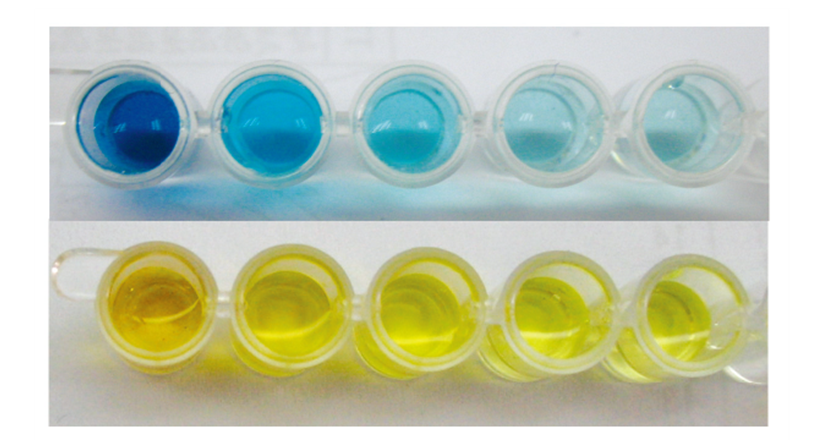
Most data deviations in ELISA experiments stem from systematic errors caused by substandard TMB chromogenic components rather than operational mistakes. Commercially available low-grade TMB substrates often suffer from insufficient purity, imbalanced component ratios and poor stability, triggering various experimental abnormalities and rendering OD values meaningless.
1. Elevated blank values and severe background coloration
Low-purity commercial TMB contains trace impurities that trigger non-specific spontaneous oxidation, producing faint color without enzymatic catalysis. This leads to excessive OD values in blank and negative wells, widening baseline errors, impairing detection sensitivity for low-concentration samples and causing false positive results. Self-prepared TMB working solutions have more severe issues including residual impurities and uneven component mixing due to unstandardized proportioning, reagent purity and homogenization processes. Spontaneous oxidation intensifies over storage time, further destabilizing blank value fluctuations.
2. Uneven color development rate and narrow linear range
High-quality commercial TMB substrates deliver uniform, controllable color development with perfect linear correlation between color intensity and sample concentration. Inferior TMB products with inaccurate component ratios show excessively fast/slow coloration or uneven local staining; high-concentration samples reach saturation rapidly while low-concentration samples generate faint signals, resulting in low standard curve R² and severely distorted quantitative results. Self-prepared TMB solutions lose core component activity rapidly if left open or improperly protected from light, leading to inconsistent color development rates, reduced substrate sensitivity, negligible coloration in low-concentration samples and complete breakdown of linear relationships.
3. Poor batch stability and insufficient repeatability
Conventional commercial TMB substrates exhibit weak storage stability and degrade under temperature and light exposure. Significant chromogenic activity differences exist across batches, leading to substantial OD deviations for identical samples with identical operations, preventing data reuse and extending experimental cycles with higher costs. Laboratory-formulated TMB lacks unified quality control standards; reagent status and activity vary with each preparation, and working solutions expire quickly after mixing. Repeated tests with newly prepared substrates yield inconsistent OD values, drastically reducing experimental repeatability and usability.
Reliable ELISA data relies on controllable, stable and precise chromogenic reactions. Through strict raw material purification and process optimization, high-grade TMB chromogenic components eliminate various coloration errors at the source, ensuring every OD value accurately reflects sample concentration to deliver precise, repeatable and traceable experimental data.
Adopts highly pure monomer TMB raw materials to remove impurities and spontaneous oxidation groups, fundamentally eliminating non-specific coloration. Blank OD values are maintained at extremely low levels with clean baselines, supporting high-sensitivity detection of trace and low-concentration samples while effectively avoiding false positive and false negative outcomes.
Optimized golden ratio of TMB and hydrogen peroxide balances detection sensitivity and stability, enabling mild, uniform and consistent enzymatic reaction rates. Color intensity correlates strongly with target antigen concentration, with standard curve linear correlation coefficient R² ≥ 0.999, greatly improving accuracy of quantitative detection for both high and low concentration samples.
Light-resistant and temperature-stable formulations undergo multiple aging tests to suppress substrate degradation. Activity remains consistent under ambient and refrigerated storage without precipitation, discoloration or activity loss. Uniform chromogenic activity across batches eliminates cross-batch data deviation and guarantees experimental repeatability.
Fully compatible with sandwich ELISA, competitive ELISA, indirect ELISA and other assay formats, it suits basic scientific research, clinical diagnostic testing, drug screening, food safety detection and other scenarios. Easy operation, rapid reaction and long-term stable readings after termination prevent data errors caused by narrow reading windows.
The core competitiveness of ELISA experiments lies not merely in "generating results", but in producing precise, credible and repeatable data. Operational errors in plate coating, incubation and pipetting can be mitigated via standardized protocols; however, inherent quality flaws in TMB substrates create systematic deviations that cannot be offset by manual operation. As the core foundation of ELISA chromogenic systems, TMB quality sets the lower limit of experimental performance. Premium TMB chromogenic components deliver high purity, superior stability and excellent linearity, forming a complete accurate workflow covering chromogenic reaction, OD measurement and quantitative analysis. It reduces invalid repeated assays and cuts reagent & time costs, ensuring all datasets withstand repeated validation and academic scrutiny.
Abandon inefficient, unstable low-grade substrates and adopt professional-grade TMB chromogenic reagents to control experimental quality from the core link, making your ELISA data more precise, reliable and persuasive!