
Leukemia: Prevalence, Development and Risk Factors
When leukemia is brought up, marrow transplantation and anemia are often the first keywords that come to mind. As the most common cancer among children and teenagers, leukemia makes up nearly one-third of all cancers in this age group. On average, approximately 14 new cases of leukemia are diagnosed per 100,000 people (men and women alike) in the United States each year. It ranks as the tenth most prevalent cancer based on annual new diagnoses and constitutes 3.5% of all new cancer cases in the country. Given this, what exactly is leukemia, and what different types does it have?
1
What is Leukemia?
Leukemia is a malignant clonal disorder of hematopoietic stem cells. Within the clone, leukemia cells become arrested at various stages of development due to uncontrolled proliferation, failed differentiation, and impaired apoptosis. In the bone marrow and other hematopoietic tissues, leukemia cells multiply and accumulate in large quantities, infiltrating other tissues and organs and thereby inhibiting normal hematopoietic function. As shown in Figure 1, normal blood consists of red blood cells (RBCs), white blood cells (WBCs), and platelets. In cases of leukemia, leukemia cells outnumber normal blood cells.
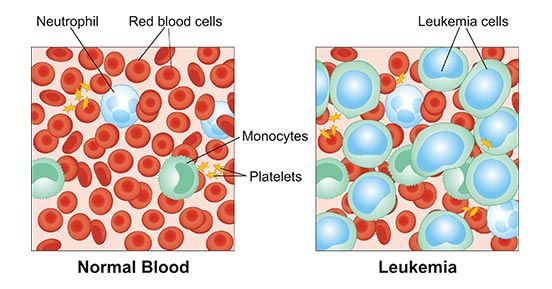
Figure 1. a diagram of components of normal blood and leukemia
In general, leukemia refers to cancers affecting white blood cells. WBCs play a critical role in protecting the body against infections caused by bacteria, viruses, and fungi. In leukemia, the WBCs are abnormal—unlike healthy WBCs, they divide too quickly and eventually crowd out normal cells. Most WBCs are produced in the bone marrow, though certain types are also generated in the lymph nodes, spleen, and thymus gland.
2
What are The Types of Leukemia?
Clinically, there are numerous types of leukemia. Based on the rate of disease progression, leukemia is divided into two categories: acute leukemia and chronic leukemia. In acute leukemia, leukemia cells multiply rapidly, leading to a fast progression of the disease. In chronic leukemia, the disease progresses slowly, and early symptoms may be very mild.
While leukemia is most commonly a cancer of the white blood cells, some forms originate from other types of blood cells. Classified by cell type, leukemia falls into two groups: myelogenous leukemia, which develops from the myeloid cell line, and lymphocytic leukemia, which arises from the lymphoid cell line.
Thus, there are four major types of leukemia in clinical practice. As shown in the table below, acute myelogenous leukemia is the most common form. Chronic lymphocytic leukemia has the highest five-year survival rate. Most childhood leukemias are acute lymphocytic leukemia (ALL), with the remaining cases mostly being acute myeloid leukemia (AML). Chronic leukemias are rare in children.
| Acute myeloid leukemia | Acute lymphocytic leukemia | Chronic myelogenous leukemia | Chronic lymphocytic leukemia | |
|---|---|---|---|---|
| Abbreviation | AML | ALL | CML | CLL |
| Prone group | Children and adults | Children | Adults | Adults |
| annual new cases in the United States | 21,000 | 6,000 | 9,000 | 20,000 |
| Five-year survival rate | 26.9% | 68.2% | 66.9% | 83.2% |
In addition to these four main types, there are various subtypes of leukemia. Subtypes of lymphocytic leukemia include hairy cell leukemia, Waldenstrom's macroglobulinemia, prolymphocytic leukemia, and lymphoma cell leukemia.
3
How does Leukemia Develop?
What causes leukemia? This is a common question among patients and their parents. As previously noted, blood contains three types of cells: red blood cells, white blood cells, and platelets. White blood cells fight infections, red blood cells carry oxygen, and platelets aid in blood clotting. Each day, the bone marrow produces billions of new blood cells, most of which are red blood cells. When a person has leukemia, their body produces more white blood cells than it needs.
These leukemia cells are not as effective at fighting infections as normal white blood cells. Moreover, their large numbers begin to impair organ function. Over time, this can lead to a shortage of red blood cells (for oxygen transport), platelets (for clotting), and normal white blood cells (for infection fighting).
Generally, leukemia develops when the DNA of certain blood cells (primarily white blood cells) mutates or becomes damaged, impairing the cells' ability to regulate their activities. Specific abnormalities cause these cells to grow and divide more rapidly and to survive longer than normal cells, which would typically die. Over time, these mutated cells replace and crowd out healthy blood cells in the bone marrow, resulting in fewer healthy white blood cells, red blood cells, and platelets—leading to the signs and symptoms of leukemia.
4
What are the Causes and Risk Factors of Leukemia?
What causes leukemia? This question is frequently asked by patients and parents alike. Currently, scientists have not identified the exact causes of leukemia, but it appears to arise from a combination of genetic and environmental factors. Most subtypes of childhood leukemia originate from genetic mutations that occur before birth, though only a small portion of these preleukemic clones progress to full-blown leukemia.
While leukemia cannot be prevented, certain factors (known as risk factors) may increase the likelihood of developing it. A risk factor is anything that affects a person’s chance of contracting a disease. Having one or more risk factors does not guarantee that a person will develop leukemia, but it is still important to be aware of them, as some actions may help reduce risk. The risk factors for leukemia include:
• Exposure to high levels of radiation or chemotherapy: This includes having received radiation therapy or chemotherapy for a previous cancer, though this risk factor is more significant for some types of leukemia than others.
• Certain viruses: The human T-lymphotropic virus (HTLV-1) is linked to leukemia.
• Exposure to benzene: A solvent used in some cleaning products and hair dyes.
• Family history of leukemia: Having a sibling with leukemia poses a low but significant risk. If a person has an identical twin with leukemia, their own risk of developing the cancer is 1 in 5.
• Genetic disorders such as Down syndrome: Children with Down syndrome have an extra copy of chromosome 21, which increases their risk of acute myeloid or acute lymphocytic leukemia to 2–3%—higher than in children without the syndrome.
• Smoking, which increases the risk of developing acute myeloid leukemia (AML).
• Immune suppression: Childhood leukemia may develop due to intentional suppression of the immune system, such as when a child takes medications to prevent organ rejection after a transplant.