
TGF‑beta signaling pathway | ELISA
1
Overview of TGF‑beta Signaling Cascade
The transforming growth factor beta (TGF‑β) signal cascade refers to a complete set of intracellular signal transmission events triggered by TGF‑β ligands. This signaling axis performs irreplaceable regulatory functions across numerous biological activities, including cell division, extracellular matrix synthesis, cell fate differentiation, programmed cell death, embryonic morphogenesis, organ construction, immune homeostasis and inflammatory reactions.
2
Members of the TGF‑β Superfamily
The TGF‑β superfamily encompasses a large collection of genes responsible for generating secreted signaling polypeptides. Its core subgroups contain TGF‑β isoforms, growth and differentiation factor (GDF) subfamily, extensive bone morphogenetic protein (BMP) subfamily, activin, inhibin, anti‑Müllerian hormone, follistatin (FS), Müllerian inhibiting substance (MIS), plus other identified members such as myostatin (Mstn), a protein initially isolated from mouse skeletal muscle tissue.
3
Molecular Activation Mechanism of the TGF‑β Pathway
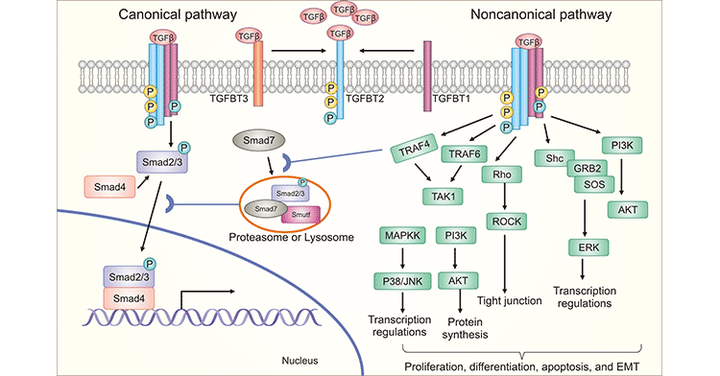
As illustrated in the pathway schematic, all ligands belonging to the TGF‑β superfamily modulate diverse cellular phenotypes such as proliferation, apoptosis, differentiation and migratory capacity. The signaling cascade initiates when a TGF‑β ligand attaches to the type II transmembrane receptor, which subsequently recruits a type I receptor to assemble a heteromeric receptor complex. The bound type II receptor then catalyzes phosphorylation and full activation of the type I receptor subunit.
Activated type I receptors carry out phosphorylation on receptor‑restricted Smad proteins (R‑Smads), which consist of Smad1, Smad2, Smad3, Smad5 and Smad8. After phosphorylation modification, R‑Smads bind to the shared co‑mediator Smad4 to create heteromeric protein assemblies. These Smad complexes then translocate from the cytoplasm into the cell nucleus. Within the nuclear compartment, Smad multimers interact synergistically with different DNA‑binding transcription factors, transcriptional co‑activators and co‑repressors to modulate the transcription levels of specific downstream target genes.
Activated type I receptors carry out phosphorylation on receptor‑restricted Smad proteins (R‑Smads), which consist of Smad1, Smad2, Smad3, Smad5 and Smad8. After phosphorylation modification, R‑Smads bind to the shared co‑mediator Smad4 to create heteromeric protein assemblies. These Smad complexes then translocate from the cytoplasm into the cell nucleus. Within the nuclear compartment, Smad multimers interact synergistically with different DNA‑binding transcription factors, transcriptional co‑activators and co‑repressors to modulate the transcription levels of specific downstream target genes.
4
TGF‑β: A Dual‑Function Regulator in Biological Systems
TGF‑β is classified as a multifunctional growth factor that elicits distinct biological outcomes on different target cell populations. Almost every somatic cell type in the body can synthesize TGF‑β and express matching membrane receptors for this ligand. It tightly modulates tissue and cellular differentiation processes, and is capable of either boosting or restraining cell proliferation in a cell‑type‑dependent manner.
Apart from its central role in governing cell growth, TGF‑β imposes substantial regulatory impacts on the organism’s immune network. It also participates in core biological processes linked to tumor onset and distant cancer metastasis.
Apart from its central role in governing cell growth, TGF‑β imposes substantial regulatory impacts on the organism’s immune network. It also participates in core biological processes linked to tumor onset and distant cancer metastasis.
Key note:R‑Smads + Smad4 = functional nuclear transcription complex